I was on my way to a showing in Granby, Connecticut, recently, when something made me do a double-take.
It wasn’t the house itself.
What caught my attention was a yard sign that said:
THIS HOME WAS HERE IN 1776
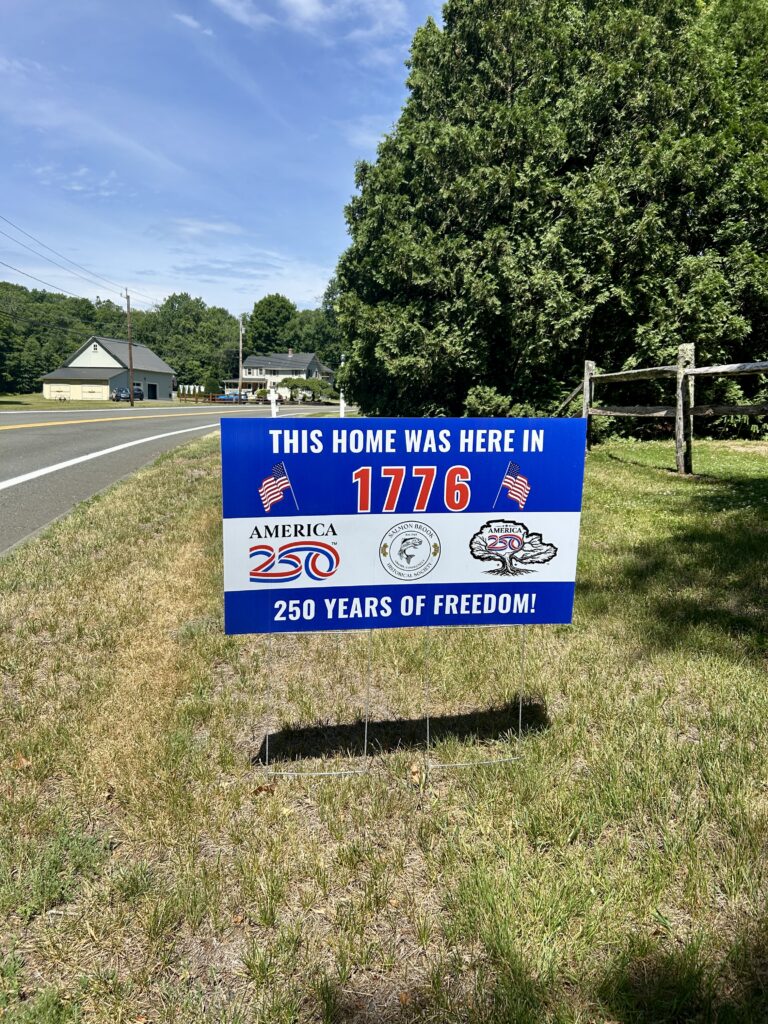
Now, I look at houses all day long. It takes a lot to make me hit the brakes.
But that sign got me.
For a moment, I stopped seeing a house and started thinking about time. That home was already standing when America became a country.
The more I thought about it, the more curious I became.
If you prefer to watch, here is a video about my experience and what I learned:
Granby has been part of my world for a long time. I grew up in Southwick, Massachusetts, less than a mile from the Connecticut border. As a teenager, I worked at High Meadow. Later, I taught dance in Granby and Simsbury. Today, as a licensed Realtor in both Massachusetts and Connecticut, I spend even more time traveling the roads that connect these communities.
That’s one of the things I love about this corner of New England. State lines exist on maps, but daily life doesn’t always follow them. People work in one town, shop in another, and build friendships that cross borders without a second thought.
So when I saw that sign in Granby, I wanted to know the story behind it.
Granby’s America 250 Project
After a little research, I learned that the signs are part of Granby’s America 250 Project, a collaboration between the Salmon Brook Historical Society and the Town of Granby’s America 250 Committee.
The idea is simple and brilliant: identify homes that were standing when the United States was founded and help residents discover the history hiding in plain sight all around them.
According to Dave Roberts, Executive Director of the Salmon Brook Historical Society, the project grew out of a recommendation from the Historical Society to the town’s America 250 Committee. The Historical Society agreed to fund the initiative, and the committee selected the slogan “This Home Was Here in 1776” from a group of submitted ideas.
Their goal was to create “a fun and engaging way for residents and visitors to discover which homes in Granby were standing when our nation was founded.”
At least 44 homes in Granby have been identified as qualifying for the program.
More Than Just an Old House
One of the things I found most interesting is that determining whether a home qualifies is not always straightforward.
Many New England homes have evolved over the centuries. Additions have been built. Rooms have been expanded. Portions of structures have changed.
Roberts explained that some homes qualify because part of the original structure remains, even if later sections were added. As long as that original pre-1776 portion still exists, the home may be eligible for the program.
The research itself was conducted by Salmon Brook Historical Society Archivist Sarah Langdon, who used historical records maintained by the Society over many decades.
That attention to detail is part of what makes the project so compelling. These signs aren’t guesses. They’re the result of careful historical research and verification.
History Hiding in Plain Sight
What I love most about the project is how it changes the way you see a place.
You can drive the same roads for years and never think twice about the homes you pass.
Then one small sign changes everything.
Suddenly, you’re looking at a building that witnessed the Revolutionary War, the founding of the United States, the Industrial Revolution, the Civil War, the arrival of automobiles, electricity, television, the internet, and everything that came after.
The house didn’t change.
Your perspective did.
That’s what happened to me in Granby.
A simple yard sign turned an ordinary drive through town into a reminder that history isn’t always preserved behind museum walls.
Sometimes it’s sitting quietly along the side of the road.
Waiting for someone to notice.
The homes of Granby aren’t the only ones quietly keeping watch over America’s earliest days. Just across the state line in Westfield, Massachusetts, the Joseph Dewey House has stood since around 1735, reminding visitors that the story of the American Revolution wasn’t confined to famous battlefields. It was also written in ordinary homes where families gathered around kitchen tables, tended their farms, and unknowingly witnessed the birth of a nation. If you’d like to continue exploring the places where history still lives, I invite you to read the first installment of my America250: Stories from Home series, The Kitchen Table at the Joseph Dewey House.
Have you spotted one of Granby’s “This Home Was Here in 1776” signs? I’d love to hear which one caught your attention.