When the Map Moved: The Joseph Moore House
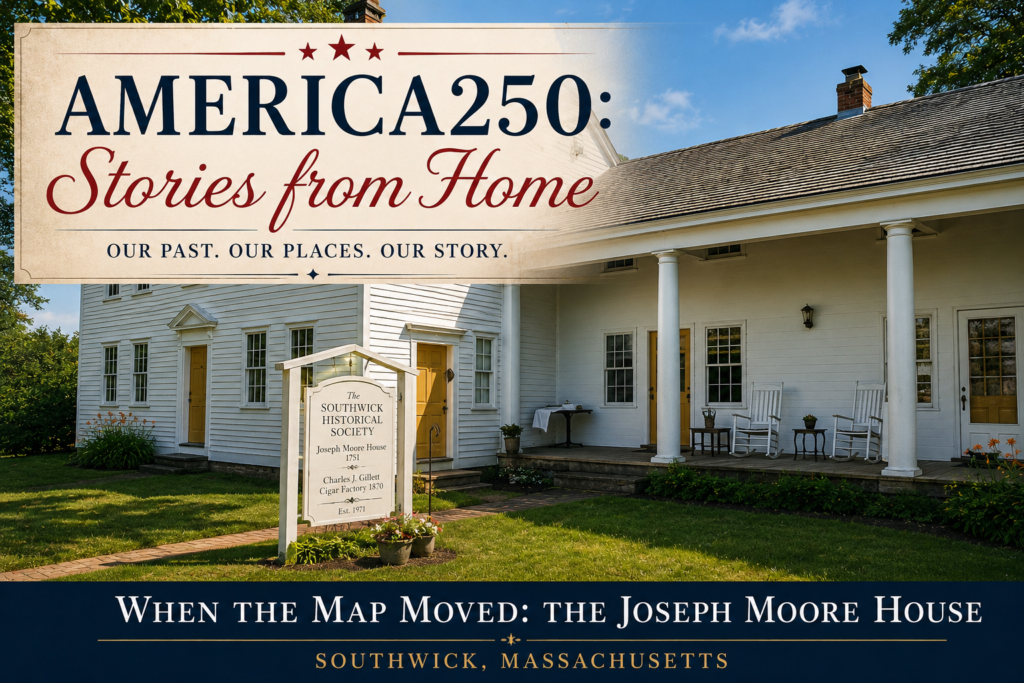
Imagine waking up one morning to discover that your address had changed. Not because you packed a moving truck or bought a new home, but because someone had redrawn the border. It sounds impossible today, yet for generations of the Moore family in Southwick, that was simply part of life.
The Joseph Moore House was built in 1751 and has remained in the same location ever since. Over the years, however, the long-running boundary dispute between Massachusetts and Connecticut shifted the political lines around it. Without ever moving the location of the house, the family found themselves living in different towns, different counties, and eventually a different state. Roger Moore, Joseph Moore’s son, would later remark that he had lived in four towns, three counties, two colonies, and two states without ever leaving the family home.
It’s a remarkable story, but it also raises an interesting question. What really makes a place home?
Today, we tend to define home by an address, a ZIP code, or the state printed on our driver’s license. For the Moore family, home wasn’t defined by lines on a map. It was the land they worked, the neighbors they depended on, and the house where they gathered at the end of each day. As governments debated where the border belonged, life inside those walls continued much as it always had.
Joseph Moore built his home twenty-five years before the Declaration of Independence was signed. During the American Revolution, he served in a Connecticut regiment, another reminder that shifting borders affected more than maps. They shaped the identities of the people who lived there and even influenced the communities they would serve.
Several years ago, I toured the Moore House, and one thing immediately struck me. This isn’t a house that has simply survived. It has been cared for. That may sound like a small distinction, but it matters.
Historic buildings don’t preserve themselves. They survive because people choose to preserve them. In Southwick, generations of volunteers with the Southwick Historical Society have done exactly that. Since the Society was founded in 1971, it has worked to save not only the Joseph Moore House but also an entire collection of buildings and artifacts that tell the story of the town’s past. Thanks to their dedication, visitors can still walk through rooms that have witnessed nearly three centuries of local history.
One detail surprised me during that visit. Attached to the carefully preserved eighteenth-century home is a later addition that continues to serve as a residence. I loved that. One part of the building preserves the past, while another continues doing what homes have always done—providing shelter, comfort, and a place where everyday life unfolds. Somehow that feels fitting for a house whose story is really about continuity.
As I left, I found myself thinking less about boundary disputes and more about the remarkable permanence of places. Governments changed. Maps were redrawn. Colonies became states. Generations came and went. Through it all, the Moore House remained exactly where it had always been, quietly witnessing history while reminding us that home is often defined by something much deeper than an address.
A Little More History
The Joseph Moore House is one of Southwick’s oldest surviving homes and the last known house associated with the Massachusetts-Connecticut “Jog.” Today it serves as the centerpiece of the Southwick Historical Society’s museum campus at 86–88 College Highway. In addition to the Moore House, the Society has preserved the Charles J. Gillett Cigar Factory, agricultural equipment, tobacco artifacts, and other pieces of Southwick’s history that might otherwise have been lost. During the summer, the Moore House and museum are open to visitors on the second and fourth Sundays from 2:00 to 4:00 p.m., making it one of the best places to experience Southwick’s history firsthand.
Southwick’s Farming Story
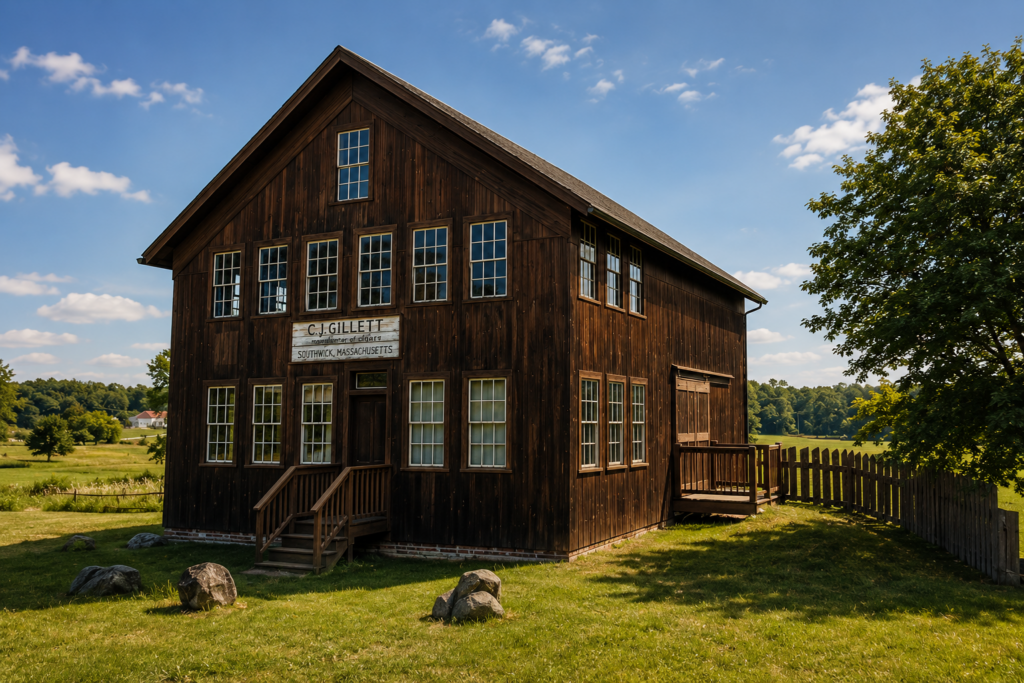
If you’ve driven past the Moore House, you’ve probably noticed the historic tobacco barn on the property. While it wasn’t part of Joseph Moore’s original farm, it represents another chapter in Southwick’s story. The Historical Society has preserved it alongside the Charles J. Gillett Cigar Factory and other agricultural artifacts to help tell the story of the tobacco industry that shaped this region generations after the Revolution.
That part of the story has always felt personal to me. I grew up in Southwick, and my summers included working tobacco, picking blueberries, tending gardens, and doing the kinds of farm chores that were simply part of growing up here. At the time, I never thought of it as history. It was just life. Looking back now, I realize I was fortunate enough to experience the closing chapters of an agricultural tradition that had shaped this community for generations.
If you’d like to learn more about Southwick’s tobacco heritage, I’ve also written about the historic tobacco barns that still dot the landscape and the important role they played in the town’s history.
As we celebrate America’s 250th anniversary, I’m grateful for the people who make stories like this possible. Every preserved home, every restored barn, every carefully cataloged artifact represents thousands of volunteer hours and a belief that local history matters. The Joseph Moore House has remained in the same place for nearly three centuries. Thanks to the Southwick Historical Society, future generations will still be able to stand there and imagine what it means to call one place home
About America250: Stories from Home
America250: Stories from Home is an ongoing series exploring the people, places, and moments that shaped Western Massachusetts and Northwestern Connecticut during America’s first 250 years.


This is fantastic Leslie. Thank you for your efforts to save the past!!
Thank YOU for reading
Thank you for highlighting the Southwick Historical Society, Inc. property and buildings that are being protected. We’ll be open on Southwick Farm Day that will be held on August 16 from 10AM to 4PM. In 2025 the Society was able to acquire an adjacent 10 acre portion of the original Moore Farm that will be placed under a Conservation Restriction for future generations to visit and enjoy.
This is a great update, thank you so much!