• Skip to main content
  • Skip to primary sidebar
  • Skip to footer

Western Mass Homes Lesley Lambert

  • Neighborhoods
    • Living in Westfield, Massachusetts
      • Stoney Hill Condominiums, Westfield, MA
      • Ridgecrest Area of Westfield, MA 01085
    • Living in Southwick, Massachusetts
  • Selling
    • Selling Your Home
  • Blog
  • About
  • Contact

park square realty

Mar 07 2022

4 Graphs that demonstrate why this is NOT a housing bubble

A recent survey revealed that many consumers believe there’s a housing bubble beginning to form. That feeling is understandable, as year-over-year home price appreciation is still in the double digits. However, this market is very different than it was during the housing crash 15 years ago. Here are four key reasons why today is nothing like the last time.

1. Houses Are Not Unaffordable Like They Were During the Housing Boom

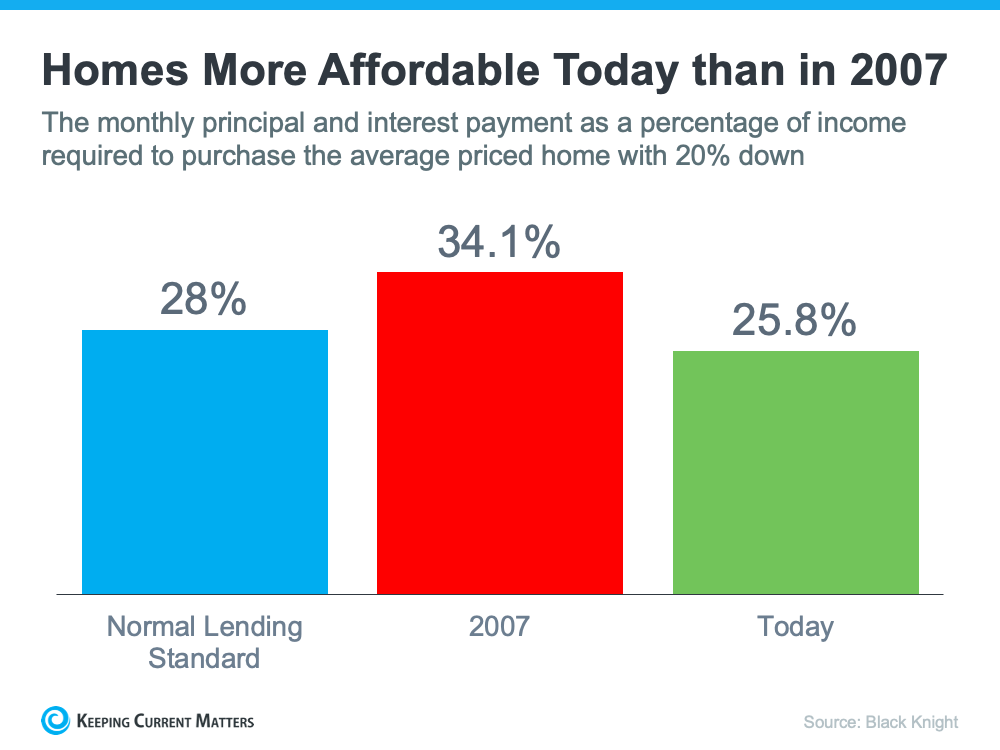
The affordability formula has three components: the price of the home, wages earned by the purchaser, and the mortgage rate available at the time. Conventional lending standards say a purchaser should not spend more than 28% of their gross income on their mortgage payment.

Fifteen years ago, prices were high, wages were low, and mortgage rates were over 6%. Today, prices are still high. Wages, however, have increased, and the mortgage rate, even after the recent spike, is still well below 6%. That means the average purchaser today pays less of their monthly income toward their mortgage payment than they did back then.

In the latest Affordability Report by ATTOM Data, Chief Product Officer Todd Teta addresses that exact point:

“The average wage earner can still afford the typical home across the U.S., but the financial comfort zone continues shrinking as home prices keep soaring and mortgage rates tick upward.”

Affordability isn’t as strong as it was last year, but it’s much better than it was during the boom. Here’s a chart showing that difference:
4 Simple Graphs Showing Why This Is Not a Housing Bubble | Keeping Current Matters

If costs were so prohibitive, how did so many homes sell during the housing boom?

2. Mortgage Standards Were Much More Relaxed During the Boom

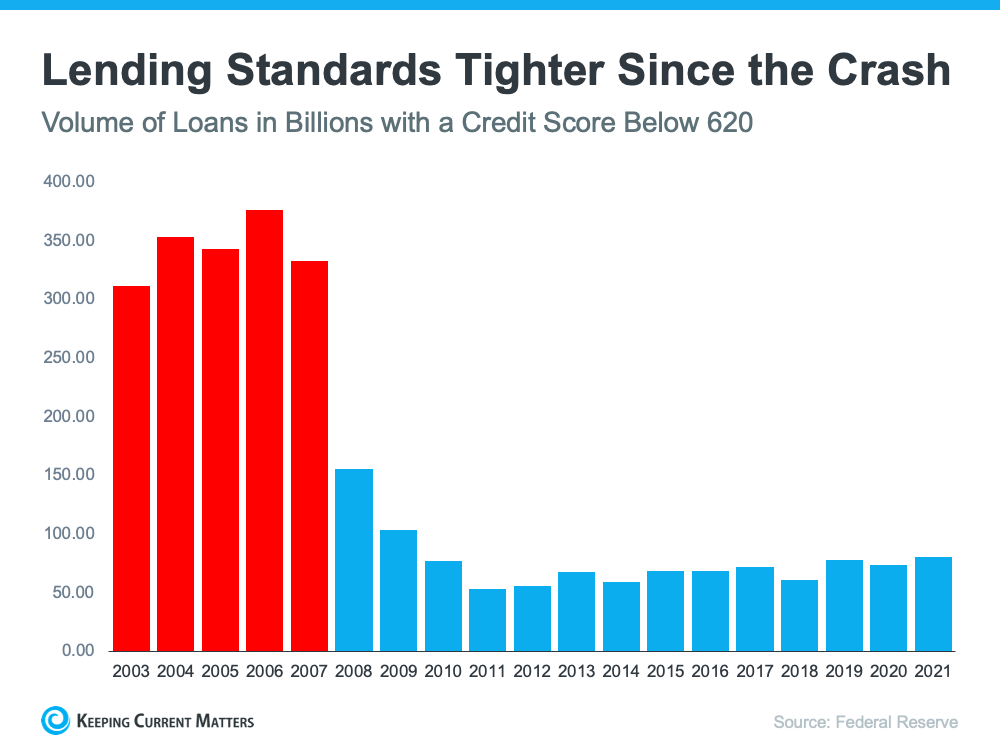
During the housing bubble, it was much easier to get a mortgage than it is today. As an example, let’s review the number of mortgages granted to purchasers with credit scores under 620. According to credit.org, a credit score between 550-619 is considered poor. In defining those with a score below 620, they explain:

“Credit agencies consider consumers with credit delinquencies, account rejections, and little credit history as subprime borrowers due to their high credit risk.”

Buyers can still qualify for a mortgage with a credit score that low, but they’re considered riskier borrowers. Here’s a graph showing the mortgage volume issued to purchasers with a credit score less than 620 during the housing boom, and the subsequent volume in the 14 years since.
4 Simple Graphs Showing Why This Is Not a Housing Bubble | Keeping Current Matters

Mortgage standards are nothing like they were the last time. Purchasers that acquired a mortgage over the last decade are much more qualified. Let’s take a look at what that means going forward.

3. The Foreclosure Situation Is Nothing Like It Was During the Crash

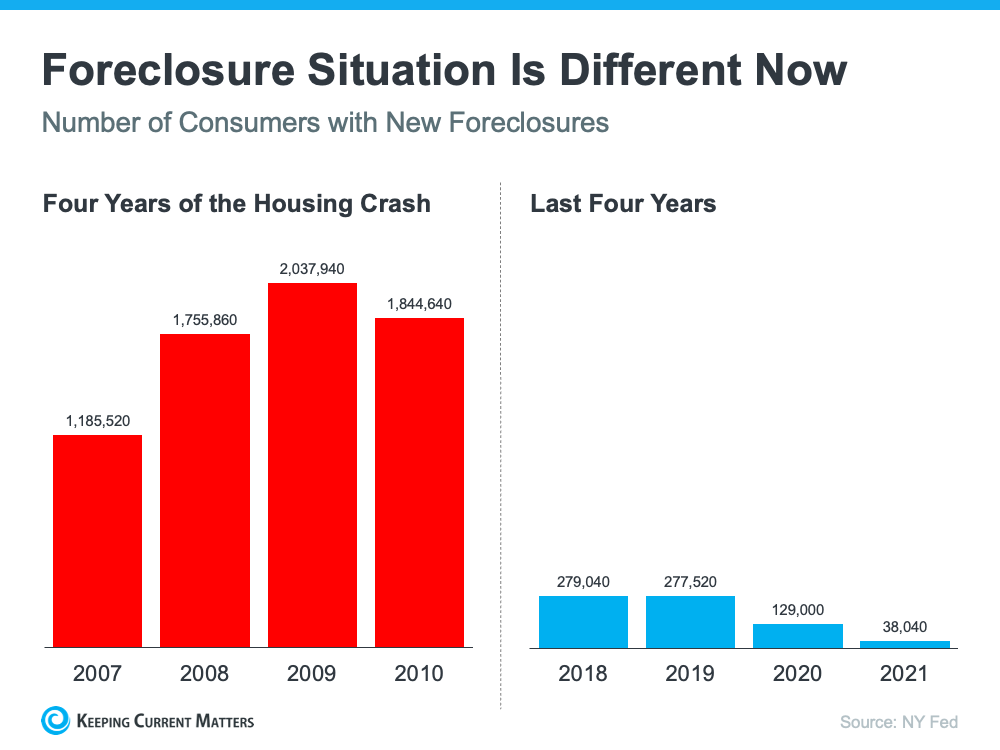
The most obvious difference is the number of homeowners that were facing foreclosure after the housing bubble burst. The Federal Reserve issues a report showing the number of consumers with a new foreclosure notice. Here are the numbers during the crash compared to today:
4 Simple Graphs Showing Why This Is Not a Housing Bubble | Keeping Current Matters

There’s no doubt the 2020 and 2021 numbers are impacted by the forbearance program, which was created to help homeowners facing uncertainty during the pandemic. However, there are fewer than 800,000 homeowners left in the program today, and most of those will be able to work out a repayment plan with their banks.

Rick Sharga, Executive Vice President of RealtyTrac, explains:

“The fact that foreclosure starts declined despite hundreds of thousands of borrowers exiting the CARES Act mortgage forbearance program over the last few months is very encouraging. It suggests that the ‘forbearance equals foreclosure’ narrative was incorrect.”

Why are there so few foreclosures now? Today, homeowners are equity rich, not tapped out.

In the run-up to the housing bubble, some homeowners were using their homes as personal ATM machines. Many immediately withdrew their equity once it built up. When home values began to fall, some homeowners found themselves in a negative equity situation where the amount they owed on their mortgage was greater than the value of their home. Some of those households decided to walk away from their homes, and that led to a rash of distressed property listings (foreclosures and short sales), which sold at huge discounts, thus lowering the value of other homes in the area.

Homeowners, however, have learned their lessons. Prices have risen nicely over the last few years, leading to over 40% of homes in the country having more than 50% equity. But owners have not been tapping into it like the last time, as evidenced by the fact that national tappable equity has increased to a record $9.9 trillion. With the average home equity now standing at $300,000, what happened last time won’t happen today.

As the latest Homeowner Equity Insights report from CoreLogic explains:

“Not only have equity gains helped homeowners more seamlessly transition out of forbearance and avoid a distressed sale, but they’ve also enabled many to continue building their wealth.”

There will be nowhere near the same number of foreclosures as we saw during the crash. So, what does that mean for the housing market?

4. We Don’t Have a Surplus of Homes on the Market – We Have a Shortage

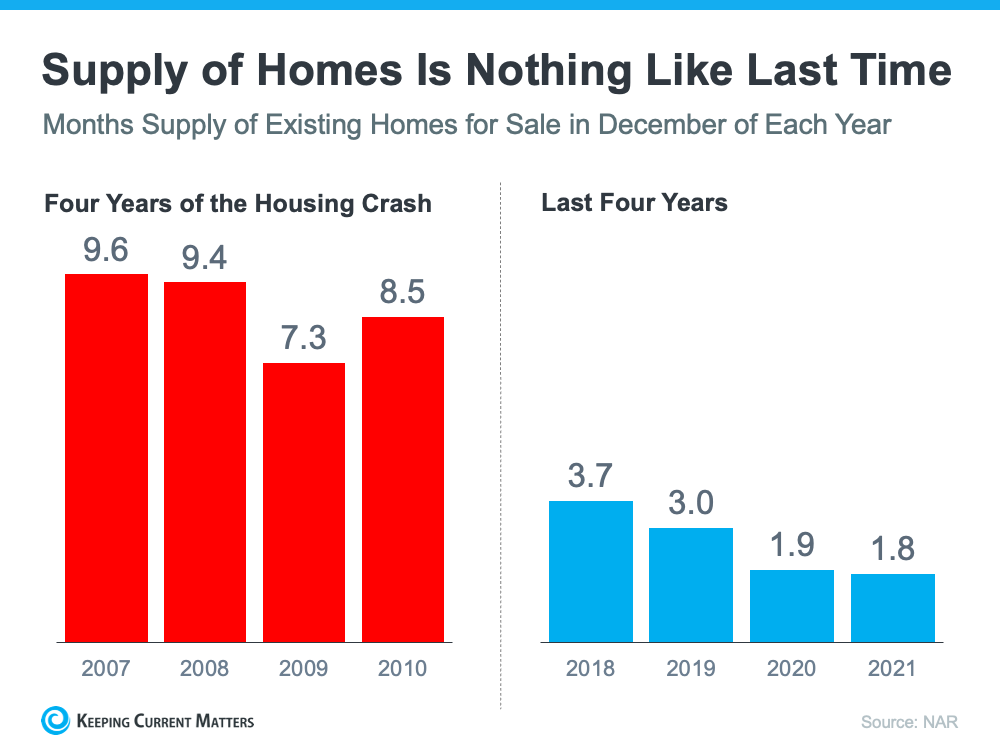
The supply of inventory needed to sustain a normal real estate market is approximately six months. Anything more than that is an overabundance and will causes prices to depreciate. Anything less than that is a shortage and will lead to continued price appreciation. As the next graph shows, there were too many homes for sale from 2007 to 2010 (many of which were short sales and foreclosures), and that caused prices to tumble. Today, there’s a shortage of inventory, which is causing the acceleration in home values to continue.
4 Simple Graphs Showing Why This Is Not a Housing Bubble | Keeping Current Matters

Inventory is nothing like the last time. Prices are rising because there’s a healthy demand for homeownership at the same time there’s a shortage of homes for sale.

Bottom Line

If you’re worried that we’re making the same mistakes that led to the housing crash, the graphs above show data and insights to help alleviate your concerns.

Lesley Lambert, Western MA REALTOR with Park Square Realty Call/text: 413-575-3611. Email: realestate.lesleylambert@gmail.com

source:https://www.keepingcurrentmatters.com/2022/02/17/4-simple-graphs-showing-why-this-is-not-a-housing-bubble/?utm_campaign=Blog_Promo&utm_content=DailyBlog&utm_medium=social&utm_source=facebook&hss_channel=fbp-295788075627

Written by Lesley Lambert · Categorized: Uncategorized · Tagged: 01085, Business and Economy, holyoke, home ownership, lesley lambert, listing, listings, market, market report, park square realty, pioneer valley, real estate, selling, Selling Your Home, southwick, Southwick Massachusetts, Towns of Western Massachusetts, west springfield, Westfield REALTOR

Jan 26 2022

With Mortgage Rates Climbing, Now’s the Time To Act on your Western MA real estate


Buying Myths
, First Time Home Buyers, For Buyers, Housing Market Updates, Interest Rates, Move-Up Buyers

With Mortgage Rates Climbing, Now’s the Time To Act

With Mortgage Rates Climbing, Now’s the Time To Act

  • 2.5KSHARES
  • 2.2K
  • 98
  • 20
  • 206

Last week, the average 30-year fixed mortgage rate from Freddie Mac jumped from 3.22% to 3.45%. That’s the highest point it’s been in almost two years. If you’re thinking about buying a home, this news may have come as a bit of a shock. But the truth is, it wasn’t entirely unexpected. Experts have been calling for rates to rise in their 2022 projections, and the forecast is now becoming a reality. Here’s a look at the projections from Freddie Mac for this year:

  • Q1 2022: 3.4%
  • Q2 2022: 3.5%
  • Q3 2022: 3.6%
  • Q4 2022: 3.7%

As the numbers show, this jump in rates is in line with the expectations from Freddie Mac. And what they also indicate is that mortgage rates are projected to continue climbing throughout the year. But should you be worried about rising mortgage rates? What does that really mean for you?

As rates increase even modestly, they impact your monthly mortgage payment and overall affordability. If you’re looking to buy a home, rising mortgage rates should be an incentive to act sooner rather than later.

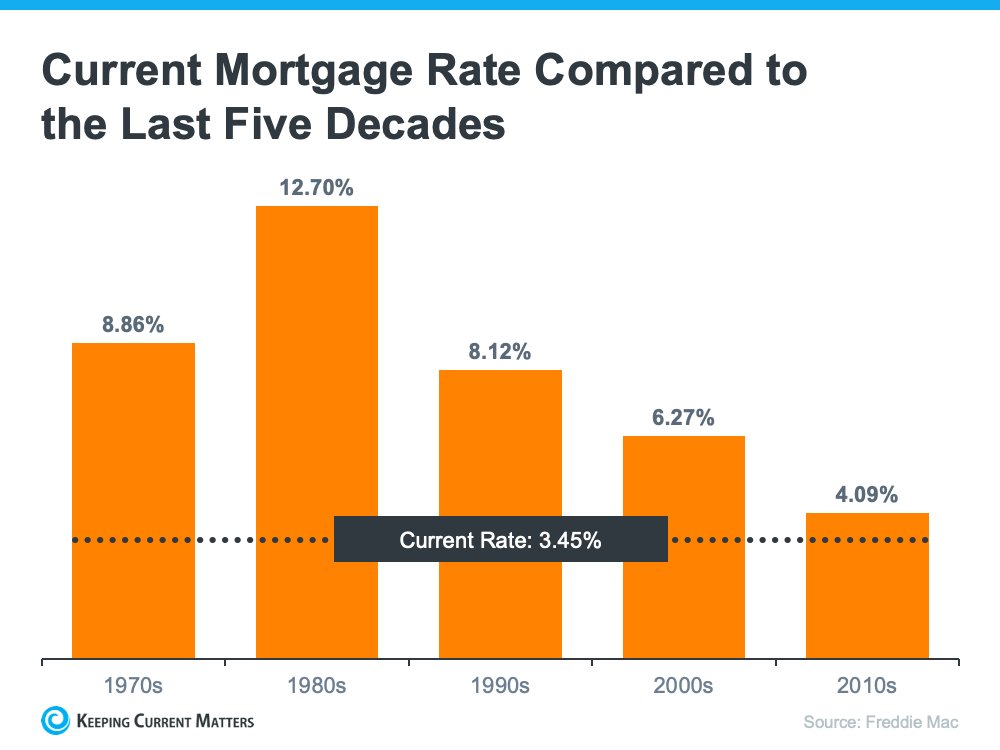
The good news is, even though rates are climbing, they’re still worth taking advantage of. Historical data shows that today’s rate, even at 3.45%, is still well below the average for each of the last five decades (see chart below):

With Mortgage Rates Climbing, Now’s the Time To Act | Keeping Current Matters

That means you still have a great opportunity to buy now with a rate that’s better than what your loved ones may have paid in decades past. If you buy a home while rates are in the mid-3s, your monthly mortgage payment will be locked in at that rate for the life of your loan. As you can see from the chart above, a lot can change in that time frame. Buying now is a great way to protect yourself from rising costs and future rate increases while also securing your payment amount for the long term.

Nadia Evangelou, Senior Economist and Director of Forecasting at the National Association of Realtors (NAR), says:

“Mortgage rates surged in the second week of the new year. The 30-year fixed mortgage rate rose to 3.45% from 3.22% the previous week. If inflation continues to grow at the current pace, rates will move up even faster in the following months.”

Bottom Line

Mortgage rates are increasing, and they’re forecast to be even higher by the end of 2022. If you’re planning to buy this year, acting soon may be your most affordable option. Work with a trusted advisor to start the homebuying process today.

To reach me: LESLEY LAMBERT, WESTERN MA REALTOR please call or text 413-575-3611

Source: https://www.keepingcurrentmatters.com/2022/01/19/with-mortgage-rates-climbing-nows-the-time-to-act/?utm_campaign=Blog_Promo&utm_medium=email&utm_source=email-broadcast&utm_content=buyers_pack&utm_term=mortgage_rates_climbing&source=

Written by Lesley Lambert · Categorized: Market Reports · Tagged: lesley lambert, ma, massachusetts, park square realty, real estate, realtor, southwick, western ma, Westfield

Jan 06 2022

A Return to ‘Normal’? The State of Real Estate in 2022 | Western Massachusetts

A Return to ‘Normal’? The State of Real Estate in 2022 | Western Massachusetts

Last year was one for the real estate history books. The pandemic helped usher in a buying frenzy that caused home prices to soar nationwide by a record 19.9% between August 2020 and August 2021.1

However, there were signs in the fourth quarter that the red-hot housing market was beginning to simmer down. In the month of October, only 60.3% of sales involved a bidding war—down from a high of 74.5% in April.2 While this trend could be attributed to seasonality, it could also be a signal that the real estate run-up may have passed its peak.

So what’s ahead for the U.S. housing market in 2022? Here’s where industry experts predict the market is headed in the coming year.

MORTGAGE RATES WILL CREEP UP

Most economists expect to see mortgage rates gradually rise this year after hitting record lows in late 2020 and early 2021.3 

Freddie Mac forecasts the 30-year fixed-rate mortgage will average 3.5% in 2022, up from around 3% in 2021.4

The Mortgage Bankers Association predicts that rates will tick up to 4% by the end of the year. “Mortgage lenders and borrowers should expect rising mortgage rates over the next year, as stronger economic growth pushes Treasury yields higher,” said Mike Fratantoni, chief economist for the Mortgage Bankers Association at their 2001 Annual Convention & Expo in October.5

However, it’s important to keep in mind that even a 4% mortgage rate is low when compared to historical standards. According to industry trade blog The Mortgage Reports, “Between 1971 and December 2020, 30-year mortgage rates averaged 7.89%.”6

What does it mean for you? Low mortgage rates can reduce your monthly payment and make homeownership more affordable. Fortunately, there’s still time to lock in a historically-low rate. Whether you’re hoping to purchase a new home or refinance an existing mortgage, act soon before rates go up any further. We’d be happy to connect you with a trusted lending professional in our network.

THE MARKET WILL BECOME MORE BALANCED

In 2021, we experienced one of the most competitive real estate markets ever. Fears about the virus and a shift to remote work triggered a huge uptick in demand. At the same time, many existing homeowners delayed their plans to sell, and supply and labor shortages hindered new construction.

This led to an extreme market imbalance that benefitted sellers and frustrated buyers. According to George Ratiu, director of economic research at Realtor.com, “Prices and sellers reached for the moon [last] year. It looks like we are now about to move back to earth.”7

Data from Realtor.com released in November showed that listing price reductions had more than doubled since February 2021. And the average days on market (an indicator of how long it takes a home to sell) has been slowly creeping up since June.7

What’s causing this change in market dynamics? The real estate market typically slows down in the fall and winter. But economists also suspect a fundamental shift in supply and demand.

At the National Association of Realtors’ annual conference last November, the group’s chief economist, Lawrence Yun, told attendees that he expects increased supply to come from an uptick in new construction—which is already underway—and an end to the mortgage forbearance program. “With more housing inventory to hit the market, the intense multiple offers will start to ease,” he said.8

Demand is also predicted to wane slightly in the coming year. Rising mortgage rates and record-high prices have made homeownership unaffordable for a growing number of Americans. And in a recent Reuters poll, nearly 80% of property analysts said they expect housing affordability to worsen over the next several years.9

What does it mean for you? If you struggled to buy a home last year, there may be some relief on the horizon. Increased supply and softening demand could make it easier to finally secure the home of your dreams. If you’re a seller, it’s still a great time to cash out your big equity gains! And with more inventory on the market, you’ll have an easier time finding your next home. Reach out for a free consultation so we can discuss your specific needs and goals.

HOME PRICES LIKELY TO KEEP CLIMBING, BUT AT A SLOWER PACE

Nationally, home prices rose an estimated 16.8% in 2021.8 But the average rate of appreciation is expected to slow down in 2022.

Danielle Hale, chief economist at Realtor.com, told Yahoo! News, “Home asking prices have decelerated in the second half of 2021, with median listing price growth slipping from a peak of 17.2% in April to just 8.6% in October.”10

But experts disagree about how much more property values can continue to climb this year. Goldman Sachs predicts that home prices will rise by 13.5%, while Fannie Mae and Freddie Mac are forecasting a 7.9% and 7% rate of appreciation, respectively.2

However, not all analysts are as bullish. The National Association of Realtors predicts a 2.8% rate of appreciation for existing homes and 4.4% for new homes, while the Mortgage Bankers Association expects the average home price to decrease by 2.5% by the end of the year.10,2

According to Hale, “With prices near all-time highs and mortgage rates expected to rise, we expect this slowdown in prices to continue.”10

What does it mean for you? If you’re a buyer who has been waiting on the sidelines for home prices to drop, you may be out of luck. Even if home prices dip slightly (and most economists expect them to rise) any savings are likely to be offset by higher mortgage rates. The good news is that decreased competition means more choice and less likelihood of a bidding war. We can help you get the most for your money in today’s market.

RENTS WILL CONTINUE TO RISE

Along with home, gasoline, and used vehicle prices, rent prices rose dramatically last year. According to CoreLogic, in September, rents for single-family homes were up 10.2% nationally year over year.11 And economists at Realtor.com expect them to climb another 7.1% in 2022.12

“Homes are expensive now…but for most people, the comparison that is most important is how that cost of homeownership is going to compare to the cost of renting,” Zillow Senior Economist Jeff Tucker told CNBC in November.13

Tucker also pointed out that rent is less predictable than a mortgage—and more likely to go up along with inflation.13

Real assets, like real estate, are often used as a hedge against inflation. That’s because property values typically rise with inflation.14 And when a homeowner takes out a mortgage, they lock in a set housing payment for the next 30 years.

In contrast, renters are at the mercy of the market—and they don’t gain any of the benefits of homeownership, like tax deductions, equity, or appreciation.

George Ratiu of Realtor.com told CNBC that he advises buyers to consider their budget and time frame. If they plan to stay in the home for at least three to five years, he believes it often makes sense to buy.13

Fortunately, it’s shaping up to be a better year for buyers. “I think 2022 has the promise of providing less competition, a lot more homes to choose from, and, as a result, a lot more approachable prices,” Ratiu said.13

What does it mean for you? Both property and rent prices are expected to continue rising. But when you purchase a home with a fixed-rate mortgage, you can rest assured knowing that your monthly mortgage payment will never go up. Whether you’re a first-time homebuyer or a real estate investor, we can help you make the most of today’s real estate market.

HERE TO GUIDE YOU

While national real estate numbers and predictions can provide a “big picture” outlook for the year, real estate is local. And as local market experts, we can guide you through the ins and outs of our market and the local issues that are likely to drive home values in your particular neighborhood. 

If you’re considering buying or selling a home in 2022, contact me now to schedule a free consultation. I’ll work with you to develop an action plan to meet your real estate goals this year.

Lesley Lambert, Western MA REALTOR with Park Square Realty 413-575-3611

Sources:

  1. Fortune –
    https://fortune.com/2021/11/04/us-home-prices-real-estate-forecast-2022-outlook/
  2. Fortune –
    https://fortune.com/2021/11/29/housing-market-real-estate-predictions-2022-forecast/
  3. Freddie Mac –
    http://www.freddiemac.com/pmms/pmms30.html
  4. Freddie Mac – https://freddiemac.gcs-web.com/news-releases/news-release-details/freddie-mac-strong-housing-market-will-continue-even-rates-and
  5. Mortgage Bankers Association –
    https://www.mba.org/2021-press-releases/october/mba-annual-forecast-purchase-originations-to-increase-9-percent-to-record-173-trillion-in-2022
  6. The Mortgage Reports –
    https://themortgagereports.com/61853/30-year-mortgage-rates-chart
  7. Realtor.com –
    https://www.realtor.com/news/trends/has-housing-market-peaked/
  8. National Association of Realtors –
    https://www.nar.realtor/newsroom/nars-yun-says-housing-market-doing-well-may-normalize-in-2022
  9. Reuters –
    https://www.reuters.com/world/us/rise-us-house-prices-halve-next-year-affordability-worsen-2021-12-07/
  10. Yahoo! News –
    https://www.yahoo.com/now/where-home-prices-headed-2022-130012748.html
  11. CNBC –
    https://www.cnbc.com/2021/11/16/inflation-rent-for-single-family-homes-surged-10percent-in-september.html
  12. Realtor.com –
    https://www.realtor.com/news/trends/what-to-expect-in-2022-housing-market/
  13. CNBC –
    https://www.cnbc.com/2021/11/23/rising-inflation-hot-housing-market-what-you-need-to-know-about-buying-a-home.html
  14. Money –
    https://money.com/inflation-2021-stocks-bitcoin-gold-reits-commodities/

Written by Lesley Lambert · Categorized: Market Reports · Tagged: 01077, agawam, Business and Economy, buying a home, first time homebuyer, home for sale, home ownership, homes, house, park square realty, pioneer valley, real estate, real estate agent, report, selling, Selling Your Home, southwick, Towns of Western Massachusetts, western ma, Westfield Massachusetts, Westfield REALTOR

Nov 09 2021

Westfield, MA REAL ESTATE MARKET REPORT, November 2021 by Lesley Lambert, REALTOR

Westfield, MA Real Estate Market Report, November 2021 by Lesley Lambert, Westfield REALTOR

You may be curious to know what has happened in the real estate market in Westfield, MA over the past twelve months. I have taken the time to create a report that shows you the market statistics and changes over the past year.

If you are considering selling or buying a home I would love to have a personal consultation with you to determine how to best meet your goals and needs.

Take a look at the current report and let me know if you have questions. Lesley Lambert, Westfield REALTOR with Park Square Realty 413-575-3611.

Westfield, MA Real Estate Market Report Nov 2021 from Lesley Lambert

  • Abouthom.es Girls
  • Decor Tips
  • Downsizing for Seniors
  • E-books
  • foreclosure
  • Guest Posts
  • Home Buying
  • Lesley's Life
  • Listings
  • Maintenance
  • Market Reports
  • Podcast: The Real Estate Ladies of Western MA
  • Selling during a divorce
  • Selling Your Home
  • Short Sale E-book
  • Short Sale/Foreclosure
  • Social Media
  • Southwick, MA
  • Testimonials
  • The Real Estate Ladies of Western MA Videos
  • The TREW Show
  • Towns of Western Massachusetts
  • Uncategorized
  • Various
  • Westfield

Written by Lesley Lambert · Categorized: Uncategorized · Tagged: 01085, home for sale, homes for sale, park square realty, Real estate broker, realtor, selling a home, Towns of Western Massachusetts, Westfield, Westfield REALTOR

Nov 04 2021

Understand What Goes into House Prices in a Competitive Market | Western MA Real Estate

Understand What Goes into House Prices in a Competitive Market | Western MA Real Estate

Article From HouseLogic.com

By: Erica Christoffer
Published: May 13, 2021

Even in a seller’s market, home sales depend on certain factors that may require you to be flexible.

You may be selling a home in a competitive market — for example, with low inventory and high demand. And you may be thinking “Yay!” or at least “Whew.” You know you’re likely to have more interested buyers, better offers, and a quicker trip to contract than you’d have otherwise. But along with that good news comes the need to manage your expectations by understanding what determines house prices and home sales. Factors include the right real estate agent, local market conditions, buyer preferences, seasonality, and mortgage rates versus inventory.

 Work with the Right Real Estate Agent to Sell Your Home

 House prices come down to the micro real estate market, says Jasen Edwards, a real estate coach and former member of REALTOR? magazine’s 30 Under 30. “What’s going on in the U.S. as a whole is different than what’s going on in Austin, Texas. [And both are] different than what’s going on in your neighborhood,” he says. “You might hear that it’s a strong seller’s market, but you might be in a micro buyer’s market.”

 Edwards advises researching your market on your own, then interviewing real estate professionals to find the best person to work with. Sellers should approach working with an agent as though they’re forming a team. You’ll be creating a plan together on how to maximize home pricing, Edwards says.

 Bernadette Inez and her broker created such a team. Inez, who had lived in the same southwest Chicago home for 26 years, needed to sell last fall when she was going through a divorce. She wanted a real estate professional who could give her strong guidance in determining an asking price.

 Inez learned about Erika Villegas, managing broker and co-owner of RE/MAX In The Village in Oak Park, Ill., through Villegas’ community sponsorships and networking events. After an initial consultation, Inez hired Villegas to list her home.

 Consider Local Market Conditions that Affect House Prices

 Villegas did a hyper local market analysis and found the price of houses similar to Inez’s to be about $229,000. She recommended listing at $239,900, mainly because of the area’s lack of inventory and extremely low days on market. It was the right call. The house had 35 showings in the first 48 hours and generated five offers at $10,000 above the asking price.

 Sometimes home improvements are needed to maximize the price. When Inez decided to put her home on the market, she opted to do some updates to appeal to more buyers. The 1950s tile in one of her bathrooms was showing its age, so she hired a contractor to install a vinyl covering. She hired someone to reglaze the tub in her other bathroom and replace all faucets, including in the kitchen. She also repainted her living room.

 Think about Buyer Preferences that May Affect Your Home Pricing

 In addition to home condition, other factors, including buyer preferences, affect price. Being located on a busy street or alley, for instance, may deter some buyers.

“I put myself in the buyers’ shoes [about] what they’re seeing in the home,” Villegas says. “For instance, many are home schooling right now. That is influencing which features buyers want in a home.”

 Know that Seasonality May Be a Factor

 Seasonality has historically been a factor, but 2020 was an exception, when strong home sales extended into late fall and early winter. Existing-home sales in November were up almost 26%, and sales prices nearly 15% from the previous year, according to the National Association of REALTORS?. Transactions and house prices nationwide traditionally trend up in the summer, when home shopping activity is high. They slow in the winter, when demand wanes. Demand also correlates with Americans’ higher mobility rates in the summer, when school is out. However, seasonality is also regional, with markets in the Northeast and Midwest peaking more significantly in the summer than the South and West, NAR reports.

“Listed homes have been going under contract on average at less than a month due to a backlog of buyers wanting to take advantage of record-low mortgage rates,” says Lawrence Yun, NAR’s chief economist.

 Weigh Mortgage Rates Against Inventory

 Low interest rates can of course make purchasing a home more affordable for buyers. However, the lack of homes on the market has created stiff competition among buyers. In fact, it often puts them in bidding wars, nullifying the benefit of the low rates. According to Redfin, record low interest rates have increased home buyers’ purchasing power by 6.9%. But higher home prices have cancelled out the effect.

 In multiple offer situations, Villegas creates a spreadsheet outlining the terms and pricing of each offer for her clients. She then calls the loan officers of the potential buyers to make sure their information has been verified. After that, Villegas goes through each offer one by one with her sellers. Together, they evaluate which one is not only the best, but also the most secure. She also helps her sellers prepare for the appraisal by creating a list of the home’s updates from the past few years.

 Why You May Need to Be Flexible

 Flexibility is a plus, even when circumstances seem to favor sellers. Low inventory and aggressive house prices are compromising many buyers’ ability to afford a home. Sellers should be prepared to make adjustments if necessary.

“No one has a crystal ball,” says Edwards. Ideally, the seller should list at a price that gets attention and triggers a lot of interest, he adds.

 When buyers are continuing to take advantage of ultra-low interest rates, a seller’s market will remain in areas with sought-after price points and a low inventory of homes for sale.

If you want to discuss this in greater detail specific to our Western MA real estate market, I would love to meet with you! Lesley Lambert, Western MA REALTOR with Park Square Realty 413-575-3611

Written by Lesley Lambert · Categorized: Uncategorized · Tagged: 01077, agawam, Home Buying, home for sale, home maintenance, homes, park square realty, pioneer valley, Real estate broker, selling a home, Selling Your Home, southwick, Southwick Massachusetts, Towns of Western Massachusetts, west springfield, western ma, Westfield

  • « Go to Previous Page
  • Page 1
  • Interim pages omitted …
  • Page 7
  • Page 8
  • Page 9
  • Page 10
  • Page 11
  • Interim pages omitted …
  • Page 25
  • Go to Next Page »

Primary Sidebar

Recent Posts

  • Why Homes Come Back on the Market (And What It Actually Means)
  • What It’s Really Like to Live in Western Massachusetts (It’s Not What You Think)
  • 3 Bedroom Ranch for Sale in Westfield Massachusetts Near Columbia Greenway – 11 Laurel Terrace
  • Should You Sell Your House Now? Western MA and Northwest CT Real Estate Market Update
  • New Listing in Stoney Hill Condominiums | 419 Southwick Rd, P66, Westfield, MA

Categories

  • Abouthom.es Girls
  • Decor Tips
  • Downsizing for Seniors
  • E-books
  • foreclosure
  • Guest Posts
  • Home Buying
  • Lesley's Life
  • Listings
  • Maintenance
  • Market Reports
  • Podcast: The Real Estate Ladies of Western MA
  • Selling during a divorce
  • Selling Your Home
  • Short Sale E-book
  • Short Sale/Foreclosure
  • Social Media
  • Southwick, MA
  • Testimonials
  • The Real Estate Ladies of Western MA Videos
  • The TREW Show
  • Towns of Western Massachusetts
  • Uncategorized
  • Various
  • Westfield

Footer

“Lesley”
Western MA Realtor- Lesley Lambert
413-575-361
Send Me A Text Message
Email Lesley
“logo”
Custom WordPress Site by 210 Consulting- Social Media Advisors