• Skip to main content
  • Skip to primary sidebar
  • Skip to footer

Western Mass Homes Lesley Lambert

  • Neighborhoods
    • Living in Westfield, Massachusetts
      • Stoney Hill Condominiums, Westfield, MA
      • Ridgecrest Area of Westfield, MA 01085
    • Living in Southwick, Massachusetts
  • Selling
    • Selling Your Home
  • Blog
  • About
  • Contact

Westfield REALTOR

Feb 26 2026

When Rates Dip Below 6%, Sellers Gain Leverage: A Western MA & NW CT View

Mortgage rates have recently dipped below 6%, and most of the conversation is focused on buyers.

Lower rates improve affordability. Buyers qualify more easily. Monthly payments soften slightly.

But there is another side to this story — and it matters if you are a homeowner thinking about listing.

When rates ease, even modestly, more buyers enter the market. Buyers who were previously on the sidelines may re-engage. Buyers who were stretching before may now qualify more comfortably. And in Western Massachusetts and Northwest Connecticut, where inventory remains limited in many price ranges, that shift can strengthen a seller’s position.

More buyers means more activity.

More activity can mean stronger offers.

Stronger offers often mean cleaner terms.

And cleaner terms create leverage.

Why This Matters If You’re Considering Listing

If you have been quietly asking yourself whether this is the right time to sell, rate movement is one of the signals worth paying attention to.

It does not mean you must rush.

It does mean the dynamic can change faster than people expect.

Many long-term homeowners hesitate not because the market is bad, but because they are waiting for clarity. They want to understand whether they are stepping into strength or uncertainty.

When buyer affordability improves, sellers often step into strength.

That does not guarantee bidding wars.

But it can increase negotiating power, reduce risk, and create momentum.

The Western MA & Northwest CT Factor

Our local markets do not move exactly like national headlines suggest. Towns like Westfield, Southwick, Granby CT, and Simsbury CT each have their own inventory patterns and buyer behavior.

In a supply-constrained micro-market, a modest rate drop can have an outsized impact.

That is why looking at national news alone is not enough. Local leverage is built on local conditions.

If you have owned your home for many years and are beginning to wonder whether this is your window, now may be a smart time to evaluate your position.

Not from a place of urgency.

From a place of clarity.

If you would like to talk through what this shift means for your specific property and neighborhood, I am always happy to have that conversation.


Lesley Lambert, REALTOR for Park Square Realty serving Western MA and Northwest CT. 413-575-3611

Written by Lesley Lambert · Categorized: Selling Your Home · Tagged: 01077, 01085, agawam, agent, Business, Business and Economy, buying a home, condo, facebook, for sale, foreclosure, home, home for sale, homes, homes for sale, house, lesley lambert, ma, market report, marketing, massachusetts, open house, park square realty, pioneer valley, ranch, real estate, Real estate broker, realtor, selling, selling a home, Selling Your Home, short sale, short sales, Social Media, southwick, Southwick Massachusetts, testimonial, Towns of Western Massachusetts, twitter, United States, western, western ma, Westfield, Westfield Massachusetts, Westfield REALTOR

Feb 09 2024

Exploring Westfield, MA Black Squirrels!

🌳✨ Exploring Westfield’s Black Squirrels! 🐿️

Hey Westfield, I’m thrilled to share a video that takes you on a journey into the enchanting world of our beloved black squirrels, the true darlings of our city!

Black Squirrels of Westfield MA

In this very short video, I will share a quick history of how these unique creatures came to Westfield, MA.

But hold on, there’s more to the story – I’m not just your local realtor; I’m a Westfield enthusiast who has lived here since 1988! 🏡💚 Join me in unraveling the charm of our hometown, one squirrel at a time.

If you would like even more information on the story of the Black Squirrels of Westfield, MA, check out this article that I wrote: https://westernmahomes.net/westfield-ma-home-of-the-black-squirrel/

Whether you’re contemplating a move or simply curious about real estate in Westfield, I’ve got your back! 🏠 Feel free to reach out anytime via email at:

  1. 📞 Phone: 413-575-3611
  2. 📧 Email: realestate.lesleylambert@gmail.com

Lesley Lambert, Westfield REALTOR, Park Square Realty

Written by Lesley Lambert · Categorized: Uncategorized · Tagged: black squirrels, lesley lambert, massachusetts, park square realty, real estate, realtor, Stanley Park, western ma, western massachusetts, Westfield, Westfield Massachusetts, Westfield REALTOR

Jul 11 2023

Westfield, MA Real Estate Market Report: First Half of 2023, Lesley Lambert-Westfield REALTOR

Westfield, MA Real Estate Market Report: First Half of 2023

Welcome to the Westfield, MA Real Estate Market Report for the first half of 2023! We’re here to provide you with an overview of the current market trends and key statistics that will help you navigate the real estate landscape in our vibrant community. Whether you’re a homeowner, a buyer, or an investor, this report will give you valuable insights into the market conditions.

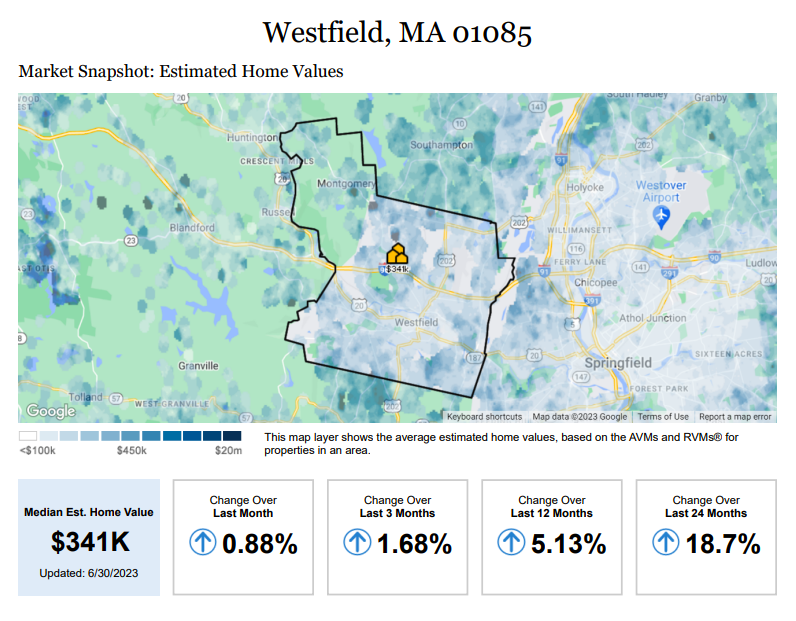
Median Estimated Home Value:

The median estimated home value in Westfield, MA currently stands at $341,000. Over the past month, we’ve seen a positive growth of 0.88% in home values. Looking at the broader picture, the past three months have shown an increase of 1.68%, while the past 12 months have experienced a significant growth of 5.13%. These upward trends indicate a robust real estate market in Westfield, MA.

Median Sales Price:

The median sales price for homes in our area is currently $377,000. In the last month, we’ve witnessed a substantial increase of $27,630 in the sales price, reflecting a positive change of 7.63%. Over the past three months, the sales price has risen by an impressive 33.27%, and over the past 12 months, it has shown a notable growth of 10.74%. These figures demonstrate the strong demand and appreciation in the Westfield, MA housing market.

Seller’s Market with Low Inventory:

The Westfield, MA real estate market remains a seller’s market, characterized by low inventory levels and high buyer demand. Homes that are priced correctly continue to sell quickly and often at the asking price or even above. It’s crucial for sellers to work with an experienced real estate professional who can help them navigate this competitive market and maximize their selling potential.

In such a dynamic and fast-paced market, having accurate information and expert guidance is essential. As a trusted local REALTOR® with in-depth knowledge of the Westfield, MA area, I am here to assist you every step of the way. Whether you’re interested in selling your home or exploring the available buying opportunities, I can provide you with personalized advice and comprehensive market insights.

View a video about this report HERE.

Do you have questions?:

Don’t miss out on the exciting opportunities in the Westfield, MA real estate market! Reach out to me, Lesley Lambert, your local real estate expert, at 413-575-3611. I am here to answer your questions, provide you with a free home evaluation, and guide you through the process with professionalism and care.

Stay informed and make informed decisions. Let’s work together to achieve your real estate goals in the thriving Westfield, MA market!

LESLEY LAMBERT, WESTFIELD REALTOR WITH PARK SQUARE REALTY, 413-575-3611.

You can view the full report HERE.

(Note: The statistics mentioned in this report are based on current data and may be subject to change. For the most accurate and up-to-date information, please consult with a qualified real estate professional.)

Written by Lesley Lambert · Categorized: Market Reports, Uncategorized · Tagged: buying a home, lesley lambert, massachusetts, park square realty, real estate, realtor, selling a home, Towns of Western Massachusetts, western ma, Westfield, Westfield REALTOR

Mar 10 2022

Hedge Against Inflation With These 3 Real Estate Investment Types

Hedge Against Inflation With These 3 Real Estate Investment Types

The annual inflation rate in the United States is currently around 7.5%—the highest it has been since 1982.1 It doesn’t matter if you’re a cashier, lawyer, plumber, or retiree; if you spend U.S. dollars, inflation impacts you.

Economists expect the effects of inflation, like a higher cost of goods, to continue.2 Luckily, an investment in real estate can ease some of the financial strain.

Here’s what you need to know about inflation, how it impacts you, and how an investment in real estate can help.

WHAT IS INFLATION AND HOW DOES IT IMPACT ME?

Inflation is a decline in the value of money. When the rate of inflation rises, prices for goods and services go up. Therefore, a dollar buys you a little bit less with every passing day.

The consumer price index, or CPI, is a standard measure of inflation. Based on the latest CPI data, prices increased 7.5% from January 2021 to January 2022.1 A little bit of inflation is considered healthy for the economy, but 7.5% in a single year is high.

How does inflation affect your life? Here are a few of the negative impacts:

  • Decreased Purchasing Power

We touched on this already, but as prices rise, your dollar won’t stretch as far as it used to. That means you’ll be able to purchase fewer goods and services with a limited budget.

  • Increased Borrowing Costs

In an effort to curb inflation, the Federal Reserve is expected to raise the federal funds rate. Therefore, consumers are likely to pay a higher interest rate on new mortgages, car loans, and variable-rate credit cards.3

  • Lower Standard of Living

Wage growth tends to lag behind price increases. According to Moody Analytics, when adjusted for inflation, average weekly earnings in January were down 3.1% from a year earlier.4 As such, life is becoming less affordable for everyone. Inflation can force those on a fixed income, like retirees, to make lifestyle changes and prioritize essentials.

  • Eroded Savings

If you store all your savings in a bank account, inflation is even more damaging. As of February 2022, the national average interest rate for a savings account is 0.06%, not nearly enough to keep up with inflation. And economists don’t expect that rate to go much higher.3

One of the best ways to mitigate these effects is to find a place to invest your money other than the bank. Even though interest rates are expected to rise, they’re unlikely to get high enough to beat inflation. If you hoard cash, the value of your money will decrease every year and more rapidly in years with elevated inflation.

REAL ESTATE: A PROVEN HEDGE AGAINST INFLATION

So where is a good place to invest your money to protect (hedge) against the impacts of inflation? There are several investment vehicles that financial advisors traditionally recommend, including:

  • Stocks

Some people invest in stocks as their primary inflation hedge. However, the stock market can become volatile during inflationary times, as we’ve seen in recent months.5

  • Commodities

Commodities are tangible assets, like oil, livestock, and minerals. The theory is that the price of commodities should climb alongside inflation. But the classic choice–gold–hasn’t risen consistently during periods of inflation since the 1970s, according to data from Morningstar Direct.6

  • Inflation-Indexed Bonds

Treasury inflation-protected securities, or TIPS, are U.S. government-issued bonds that are indexed to the inflation rate. Bonds are considered low risk, but the returns they offer are generally low, as well.7

  • Real Estate
    Real estate prices across the board tend to rise along with inflation and often rise faster than inflation.8 That’s one of the reasons demand for real estate is soaring right now.9

We believe real estate is the best hedge against inflation. Owning real estate does more than protect your wealth—it can actually make you money. For example, home prices rose nearly 17% from 2020 to 2021, 10% ahead of the 7% inflation that occurred in the same timeframe.10 

Plus, certain types of real estate investments can help you generate a stream of passive income. In the past year, property owners didn’t just avoid the erosion of purchasing power caused by inflation; they got ahead.

TYPES OF REAL ESTATE INVESTMENTS

Though there are myriad ways to invest in real estate, there are three basic investment types that we recommend for beginner and intermediate investors. Remember that we can help you determine which options are best for your financial goals and budget.

  • Primary Residence

If you own your home, you’re already ahead. The advantages of homeownership become even more apparent in inflationary times. As inflation raises prices throughout the economy, the value of your home is likely to go up concurrently. At the same time, you’ve locked in a set mortgage payment for the next 30 years, so you’ll be immune to rising rental costs.

If you don’t already own your primary residence, homeownership is a worthwhile goal to pursue.

Though the task of saving enough for a down payment may seem daunting, there are several strategies that can make homeownership easier to achieve. If you’re not sure how to get started with the home buying process, contact us. Our team can help you find the strategy and property that fits your needs and budget.

Whether you already own a primary residence or are still renting, now is a good time to also start thinking about an investment property. The types of investment properties you’ll buy as a solo investor generally fall into two categories: long-term rentals and short-term rentals.

  • Long-Term (Traditional) Rentals

A long-term or traditional rental is a dwelling that’s leased out for an extended period. An example of this is a single-family home where a tenant signs a one-year lease and brings all their own furniture.

Long-term rentals are a form of housing. For most tenants, the rental serves as their primary residence, which means it’s a necessary expense. This unique quality of long-term rentals can help to provide stable returns in uncertain times, especially when we have high inflation.

To invest in a long-term rental, you’ll need to budget for maintenance, repairs, property taxes, and insurance. You’ll also need to have a plan for managing the property. But a well-chosen investment property should pay for itself through rental income, and you’ll benefit from appreciation as the property rises in value.

We can help you find an ideal long-term rental property to suit your budget and investment goals. Reach out to talk about your needs and our local market opportunities.

  • Short-Term (Vacation) Rentals

Short-term or vacation rentals function more like hotels in that they offer temporary accommodations. A short-term rental is defined as a residential dwelling that is rented for 30 days or less. The furniture and other amenities are provided by the property owner, and today many short-term rentals are listed on websites like Airbnb and Vrbo.

A short-term rental can potentially earn you a higher return than a long-term rental, but this comes at the cost of daily, hands-on management. With a short-term rental, you’re not just entering the real estate business; you’re entering the hospitality business, too.

Done right, short-term rentals can be both a hedge against inflation and a profitable source of income. As a bonus, when the home isn’t being rented you have an affordable vacation spot for yourself and your family!

Contact us today if you’re interested in exploring options in either the long-term or short-term rental market. Mortgage rates are expected to rise, so you’ll want to act fast to maximize your investment return.

I AM INVESTED IN HELPING YOU

Inflation is a fact of life in the U.S. economy. Luckily, you can prepare for inflation with a carefully managed investment portfolio that includes real estate. Owning a primary residence or investing in a short-term or long-term rental will help you both mitigate the effects of inflation and grow your net worth, which makes it a strategic move in our current financial environment.

If you’re ready to invest in real estate to build wealth and protect yourself from rising inflation, contact me. Our team can help you find a primary residence or investment property that meets your financial goals.

Lesley Lambert, Western MA REALTOR with Park Square Realty. 413-575-3611

Hedge Against Inflation With These 3 Real Estate Investment Types from Lesley Lambert

The above references an opinion and is for informational purposes only.  It is not intended to be financial advice. Consult the appropriate professionals for advice regarding your individual needs.

Sources:

  1. Bloomberg –
    https://www.bloomberg.com/news/articles/2022-02-10/u-s-inflation-charges-higher-with-larger-than-forecast-gain
  2. CNN –
    https://www.cnn.com/2022/01/01/economy/inflation-prices-2022-preview/index.html
  3. CNBC –
    https://www.cnbc.com/2022/01/26/the-fed-sets-the-stage-for-a-rate-hike-heres-what-that-means-for-you.html
  4. Reuters –
    https://www.reuters.com/business/us-consumer-prices-rise-strongly-january-weekly-jobless-claims-fall-2022-02-10/
  5. NBC News –
    https://www.nbcnews.com/business/markets/market-slide-dow-falls-700-points-sp-enters-correction-territory-rcna13304
  6. CNBC –
    https://www.cnbc.com/2021/12/20/gold-is-losing-its-status-as-an-inflation-hedge-two-traders-warn.html
  7. Morningstar –
    https://www.morningstar.com/articles/1079158/why-are-inflation-protected-bond-funds-losing-money
  8. The Washington Post –
    https://www.washingtonpost.com/business/2022/01/04/heres-how-inflation-could-affect-your-next-real-estate-move/
  9. Bloomberg –
    https://www.bloomberg.com/news/articles/2022-01-24/is-real-estate-a-good-investment-hedge-against-inflation-what-the-experts-say
  10. CNN –
    https://www.cnn.com/2022/01/20/homes/us-nar-home-sales-december-and-2021/index.html

Written by Lesley Lambert · Categorized: Market Reports, Uncategorized · Tagged: 01085, agawam, Business and Economy, buying a home, home for sale, home ownership, house, ma, market report, pioneer valley, realtor, Southwick Massachusetts, Towns of Western Massachusetts, Westfield, Westfield Massachusetts, Westfield REALTOR

Mar 07 2022

4 Graphs that demonstrate why this is NOT a housing bubble

A recent survey revealed that many consumers believe there’s a housing bubble beginning to form. That feeling is understandable, as year-over-year home price appreciation is still in the double digits. However, this market is very different than it was during the housing crash 15 years ago. Here are four key reasons why today is nothing like the last time.

1. Houses Are Not Unaffordable Like They Were During the Housing Boom

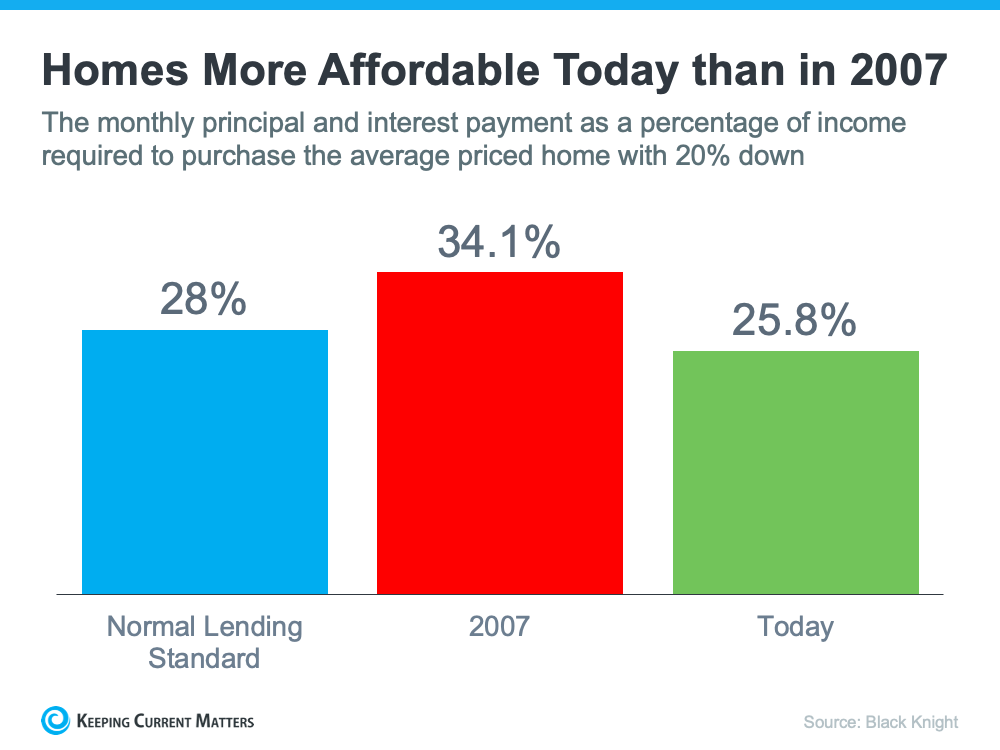
The affordability formula has three components: the price of the home, wages earned by the purchaser, and the mortgage rate available at the time. Conventional lending standards say a purchaser should not spend more than 28% of their gross income on their mortgage payment.

Fifteen years ago, prices were high, wages were low, and mortgage rates were over 6%. Today, prices are still high. Wages, however, have increased, and the mortgage rate, even after the recent spike, is still well below 6%. That means the average purchaser today pays less of their monthly income toward their mortgage payment than they did back then.

In the latest Affordability Report by ATTOM Data, Chief Product Officer Todd Teta addresses that exact point:

“The average wage earner can still afford the typical home across the U.S., but the financial comfort zone continues shrinking as home prices keep soaring and mortgage rates tick upward.”

Affordability isn’t as strong as it was last year, but it’s much better than it was during the boom. Here’s a chart showing that difference:

4 Simple Graphs Showing Why This Is Not a Housing Bubble | Keeping Current Matters

If costs were so prohibitive, how did so many homes sell during the housing boom?

2. Mortgage Standards Were Much More Relaxed During the Boom

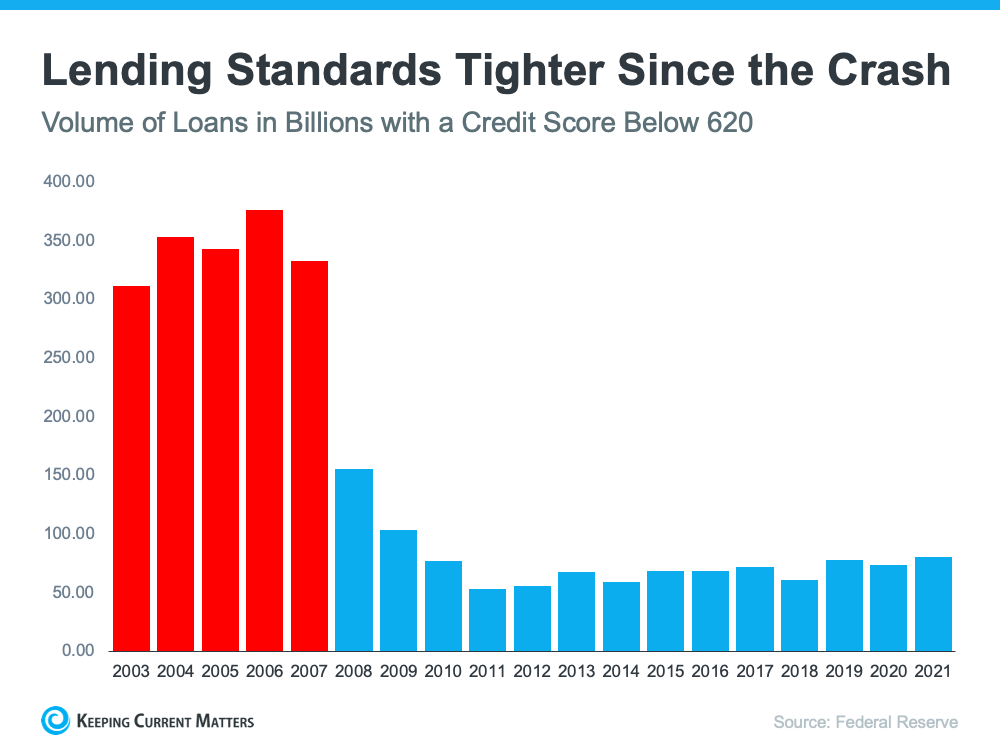
During the housing bubble, it was much easier to get a mortgage than it is today. As an example, let’s review the number of mortgages granted to purchasers with credit scores under 620. According to credit.org, a credit score between 550-619 is considered poor. In defining those with a score below 620, they explain:

“Credit agencies consider consumers with credit delinquencies, account rejections, and little credit history as subprime borrowers due to their high credit risk.”

Buyers can still qualify for a mortgage with a credit score that low, but they’re considered riskier borrowers. Here’s a graph showing the mortgage volume issued to purchasers with a credit score less than 620 during the housing boom, and the subsequent volume in the 14 years since.

4 Simple Graphs Showing Why This Is Not a Housing Bubble | Keeping Current Matters

Mortgage standards are nothing like they were the last time. Purchasers that acquired a mortgage over the last decade are much more qualified. Let’s take a look at what that means going forward.

3. The Foreclosure Situation Is Nothing Like It Was During the Crash

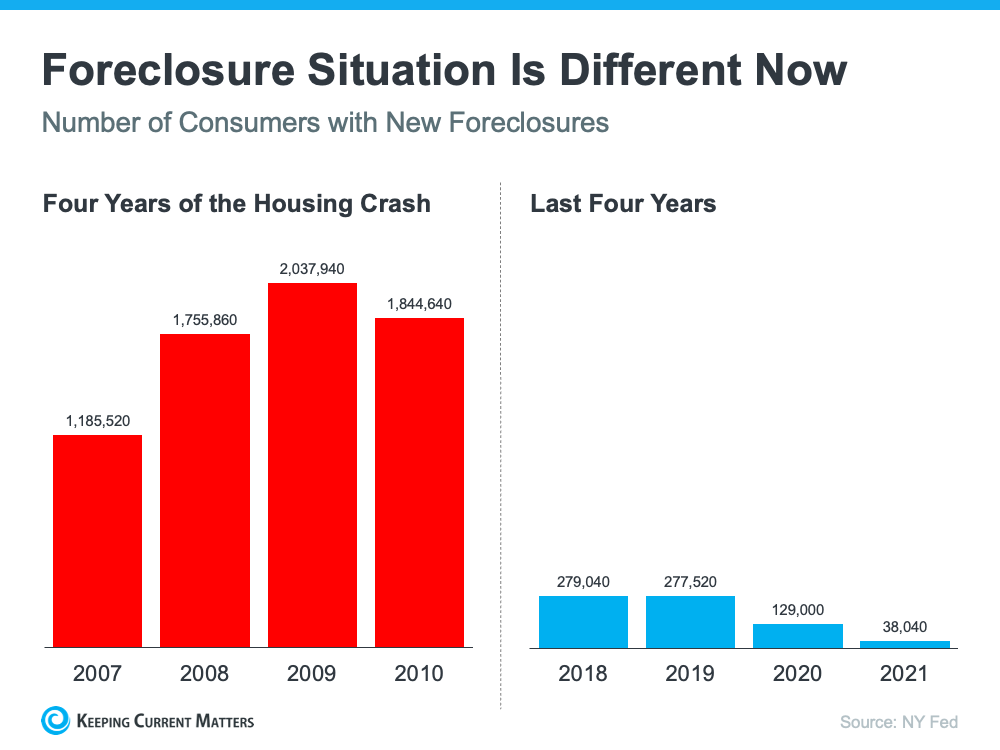
The most obvious difference is the number of homeowners that were facing foreclosure after the housing bubble burst. The Federal Reserve issues a report showing the number of consumers with a new foreclosure notice. Here are the numbers during the crash compared to today:

4 Simple Graphs Showing Why This Is Not a Housing Bubble | Keeping Current Matters

There’s no doubt the 2020 and 2021 numbers are impacted by the forbearance program, which was created to help homeowners facing uncertainty during the pandemic. However, there are fewer than 800,000 homeowners left in the program today, and most of those will be able to work out a repayment plan with their banks.

Rick Sharga, Executive Vice President of RealtyTrac, explains:

“The fact that foreclosure starts declined despite hundreds of thousands of borrowers exiting the CARES Act mortgage forbearance program over the last few months is very encouraging. It suggests that the ‘forbearance equals foreclosure’ narrative was incorrect.”

Why are there so few foreclosures now? Today, homeowners are equity rich, not tapped out.

In the run-up to the housing bubble, some homeowners were using their homes as personal ATM machines. Many immediately withdrew their equity once it built up. When home values began to fall, some homeowners found themselves in a negative equity situation where the amount they owed on their mortgage was greater than the value of their home. Some of those households decided to walk away from their homes, and that led to a rash of distressed property listings (foreclosures and short sales), which sold at huge discounts, thus lowering the value of other homes in the area.

Homeowners, however, have learned their lessons. Prices have risen nicely over the last few years, leading to over 40% of homes in the country having more than 50% equity. But owners have not been tapping into it like the last time, as evidenced by the fact that national tappable equity has increased to a record $9.9 trillion. With the average home equity now standing at $300,000, what happened last time won’t happen today.

As the latest Homeowner Equity Insights report from CoreLogic explains:

“Not only have equity gains helped homeowners more seamlessly transition out of forbearance and avoid a distressed sale, but they’ve also enabled many to continue building their wealth.”

There will be nowhere near the same number of foreclosures as we saw during the crash. So, what does that mean for the housing market?

4. We Don’t Have a Surplus of Homes on the Market – We Have a Shortage

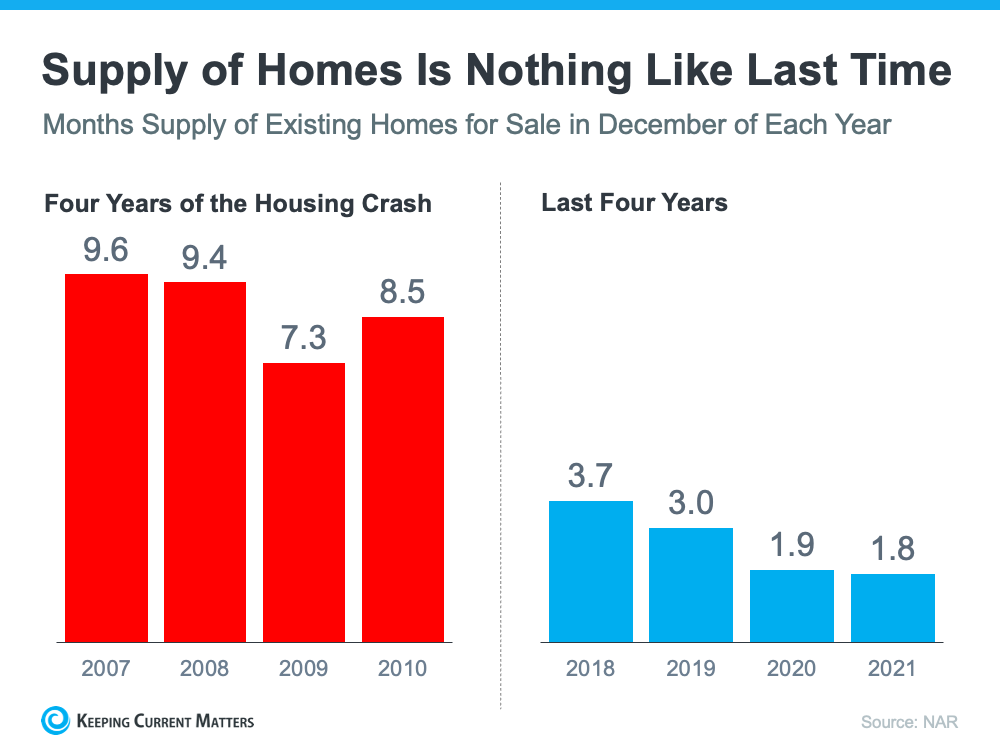
The supply of inventory needed to sustain a normal real estate market is approximately six months. Anything more than that is an overabundance and will causes prices to depreciate. Anything less than that is a shortage and will lead to continued price appreciation. As the next graph shows, there were too many homes for sale from 2007 to 2010 (many of which were short sales and foreclosures), and that caused prices to tumble. Today, there’s a shortage of inventory, which is causing the acceleration in home values to continue.

4 Simple Graphs Showing Why This Is Not a Housing Bubble | Keeping Current Matters

Inventory is nothing like the last time. Prices are rising because there’s a healthy demand for homeownership at the same time there’s a shortage of homes for sale.

Bottom Line

If you’re worried that we’re making the same mistakes that led to the housing crash, the graphs above show data and insights to help alleviate your concerns.

Lesley Lambert, Western MA REALTOR with Park Square Realty Call/text: 413-575-3611. Email: realestate.lesleylambert@gmail.com

source:https://www.keepingcurrentmatters.com/2022/02/17/4-simple-graphs-showing-why-this-is-not-a-housing-bubble/?utm_campaign=Blog_Promo&utm_content=DailyBlog&utm_medium=social&utm_source=facebook&hss_channel=fbp-295788075627

Written by Lesley Lambert · Categorized: Uncategorized · Tagged: 01085, Business and Economy, holyoke, home ownership, lesley lambert, listing, listings, market, market report, park square realty, pioneer valley, real estate, selling, Selling Your Home, southwick, Southwick Massachusetts, Towns of Western Massachusetts, west springfield, Westfield REALTOR

  • Page 1
  • Page 2
  • Page 3
  • Go to Next Page »

Primary Sidebar

Recent Posts

  • Why Homes Come Back on the Market (And What It Actually Means)
  • What It’s Really Like to Live in Western Massachusetts (It’s Not What You Think)
  • 3 Bedroom Ranch for Sale in Westfield Massachusetts Near Columbia Greenway – 11 Laurel Terrace
  • Should You Sell Your House Now? Western MA and Northwest CT Real Estate Market Update
  • New Listing in Stoney Hill Condominiums | 419 Southwick Rd, P66, Westfield, MA

Categories

  • Abouthom.es Girls
  • Decor Tips
  • Downsizing for Seniors
  • E-books
  • foreclosure
  • Guest Posts
  • Home Buying
  • Lesley's Life
  • Listings
  • Maintenance
  • Market Reports
  • Podcast: The Real Estate Ladies of Western MA
  • Selling during a divorce
  • Selling Your Home
  • Short Sale E-book
  • Short Sale/Foreclosure
  • Social Media
  • Southwick, MA
  • Testimonials
  • The Real Estate Ladies of Western MA Videos
  • The TREW Show
  • Towns of Western Massachusetts
  • Uncategorized
  • Various
  • Westfield

Footer

“Lesley”
Western MA Realtor- Lesley Lambert
413-575-361
Send Me A Text Message
Email Lesley
“logo”
Custom WordPress Site by 210 Consulting- Social Media Advisors